


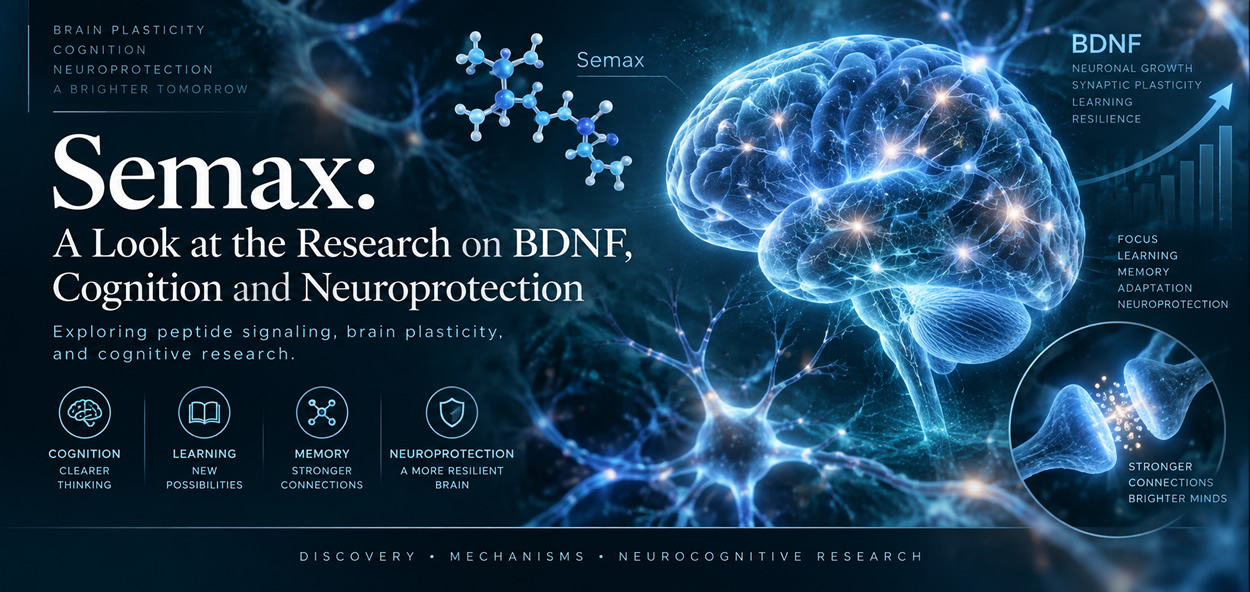
Semax is a synthetic seven-amino-acid peptide derived from a fragment of adrenocorticotropic hormone (ACTH). Researchers have studied it for its effects on neurotrophic signaling, cognitive function, memory, neurological recovery, and the brain's response to injury and ischemia.
Semax is unusual because it was designed from ACTH without retaining the adrenal-stimulating activity normally associated with the full hormone. Instead, its research has focused largely on the nervous system and on molecular pathways involved in neuronal survival, adaptation, and communication.
What Is Semax?
Semax is based on the ACTH(4-7) fragment of adrenocorticotropic hormone. ACTH is best known for stimulating the adrenal glands as part of the body's hormonal stress-response system, but researchers discovered that fragments of the molecule could have biological activity separate from those hormonal effects.
Semax was developed by modifying an ACTH fragment to create a more stable peptide while avoiding the adrenal and cortisol-stimulating effects of the full ACTH molecule.
It was developed through Russian peptide research programs and has been investigated there for several decades, particularly in neurological settings.
How Does Semax Work?
Semax does not appear to act through one simple receptor-and-response pathway. Research instead suggests effects across several signaling systems involved in brain function.
One of the most frequently studied is brain-derived neurotrophic factor (BDNF). BDNF is a signaling protein involved in neuronal survival, synaptic plasticity, learning, and memory.
Experimental research has also examined Semax in relation to nerve growth factor (NGF), gene expression, inflammatory signaling, oxidative stress, and neurotransmitter systems involving dopamine and serotonin.
Many of the detailed mechanistic findings in these areas come from animal or laboratory studies. They help explain why Semax is of neurological research interest, but they should not automatically be interpreted as demonstrated clinical effects in humans.
Semax and BDNF Research
BDNF is one of the central themes in Semax research.
Animal studies have reported changes in BDNF expression following Semax administration, along with changes involving NGF and their associated receptor systems. Researchers have investigated whether these effects contribute to changes in neuronal plasticity and the brain's response to stress or injury.
This is biologically interesting because neurotrophic factors help neurons maintain connections and adapt to changing conditions.
However, statements that Semax “raises BDNF” need context. Much of the evidence establishing these detailed changes comes from experimental animal models, and the size and timing of an effect observed in animal brain tissue cannot simply be translated into an expected effect in people.
What Has Semax Research Studied?
Major areas of investigation include:
- Neurotrophic signaling involving BDNF and NGF
- Learning, memory, and cognitive function
- Cerebral ischemia and stroke
- Neuronal survival and neuroprotection
- Oxidative and inflammatory responses
- Dopamine and serotonin signaling
- Neurological and cognitive recovery
The evidence varies substantially by research area. Semax has human clinical research behind it, particularly from Russia, but many of the specific molecular mechanisms commonly discussed in connection with Semax have been characterized primarily in animal and laboratory experiments.
Research on Cerebral Ischemia and Stroke
One of Semax's most significant research areas has been cerebral ischemia, which occurs when blood flow to part of the brain is reduced or interrupted.
Animal models of cerebral ischemia have examined whether Semax influences the molecular response to brain injury. Researchers have reported changes involving inflammatory pathways, neurotrophic signaling, oxidative stress, and genes associated with neuronal survival.
Experimental animal studies have also reported reductions in measures of ischemic brain damage under certain study conditions.
Human research has investigated Semax in patients with ischemic stroke, including its relationship with neurological recovery and neurotrophic factors such as BDNF. These studies are important because they move the research beyond laboratory models, although the clinical evidence base is not comparable in size or independent replication to that of widely established stroke therapies.
Semax and Cognitive Research
Learning and memory are another major part of the Semax literature.
Animal experiments have reported effects on memory formation and learning under several experimental conditions. These findings are consistent with the peptide's effects on signaling systems involved in synaptic plasticity.
Human studies and clinical reports from Russia have also examined attention, memory, and cognitive recovery in neurological populations.
Interpretation requires some caution. Parts of this clinical literature involve relatively small studies, and not all of it uses the large randomized, blinded, placebo-controlled designs that provide the strongest evidence for a clinical effect.
What Does Neuroprotection Mean in Semax Research?
Semax is frequently described as neuroprotective, but that term can sound more conclusive than the evidence actually is.
In experimental research, neuroprotection generally means that a compound reduces certain measures of neuronal injury or helps cells respond to damaging conditions.
Semax studies have investigated these effects in models involving ischemia, oxidative stress, inflammation, and other forms of neurological stress.
These findings support continued research into neuroprotective mechanisms. They do not mean that Semax has been proven to prevent neurological disease or protect a healthy human brain from future injury.
Research on Dopamine and Serotonin
Preclinical studies have also investigated Semax's effects on neurotransmitter systems.
Experimental research suggests that Semax can alter activity within dopamine and serotonin systems under certain conditions. These neurotransmitters participate in motivation, attention, mood, movement, reward processing, and many other brain functions.
These findings may help explain some behavioral effects observed in animal experiments, but neurotransmitter activity is highly complex. A change in dopamine or serotonin signaling in an experimental model does not by itself establish a predictable cognitive or mood effect in humans.
How Does Semax Compare With Selank?
Semax and Selank are frequently discussed together because both emerged from Russian peptide research and both have been investigated for effects involving the central nervous system.
Their research emphasis is different.
Semax research is centered more heavily on neurotrophic factors, cognition, memory, cerebral ischemia, and neuroprotection. Selank research has focused more strongly on anxiety, stress response, and emotional regulation.
There is some mechanistic overlap, including research involving BDNF and neurotransmitter signaling, but they are different peptides with different origins and should not be treated as interchangeable compounds.
Human Research vs. Preclinical Research
Separating these two evidence streams is particularly important with Semax.
Human research exists. Semax has been studied clinically, particularly in Russian neurological research and clinical practice.
At the same time, many of the detailed claims made about how Semax works — including precise changes in BDNF, NGF, neurotransmitters, gene expression, inflammation, and neuronal survival — rely heavily on animal or laboratory studies.
The human literature is also geographically concentrated, with much of the research originating from Russian institutions and some publications appearing primarily in Russian-language journals. Independent replication across larger and more diverse research populations remains limited.
That does not make the existing research irrelevant, but it does affect how confidently its findings can be generalized.
What Has Safety Research Reported?
Published clinical literature generally describes Semax as well tolerated in the populations and study periods examined.
Its design specifically separates it from the adrenal-stimulating activity of full-length ACTH, so Semax should not be assumed to produce the same hormonal effects simply because its sequence was derived from part of the ACTH molecule.
However, the available evidence does not provide the same depth of long-term safety information available for extensively studied medications. Data on prolonged exposure, uncommon adverse effects, interactions with other medications, and use across diverse patient populations remain comparatively limited.
This distinction is important because absence of a frequently reported problem in small or short studies is not the same as demonstrating its absence in much larger populations over long periods.
Why Is Semax of Research Interest?
Semax sits at an interesting intersection between peptide biology and neuroscience.
Its development from a small ACTH fragment demonstrated that portions of larger hormones can have biological effects that are quite different from the functions normally associated with the complete hormone.
Research has since connected Semax with neurotrophic signaling, neuronal plasticity, cognitive processes, neurotransmitter activity, and responses to neurological injury.
The resulting evidence base is more substantial than purely laboratory-stage peptide research because human clinical studies do exist. At the same time, many of its most detailed mechanistic findings remain preclinical, and large independently replicated clinical trials are limited.
That combination makes Semax an established subject of neurological peptide research while leaving important questions about its clinical effects and long-term safety open for further study.
Research Sources
Semax research includes laboratory studies examining its ACTH-derived structure and molecular signaling, animal studies investigating BDNF, NGF, neurotransmitter activity, learning, memory, cerebral ischemia and neuroprotection, and human clinical research involving neurological and stroke populations.
Much of the clinical literature originated from Russian research institutions, while later molecular studies have helped characterize possible mechanisms involving neurotrophic factors, gene expression, inflammatory signaling, and neuronal responses to injury. The evidence should therefore be interpreted according to study design, with mechanistic animal findings distinguished from effects demonstrated directly in humans.